
AI writing tools have transformed content creation for bloggers and website owners in 2026. These powerful platforms now combine advanced natural language processing with SEO optimization features to help you produce high-quality content faster than ever before.
Whether you’re running a personal blog, managing a business website, or creating content for clients, choosing the right AI writing assistant can dramatically improve your productivity and content quality.
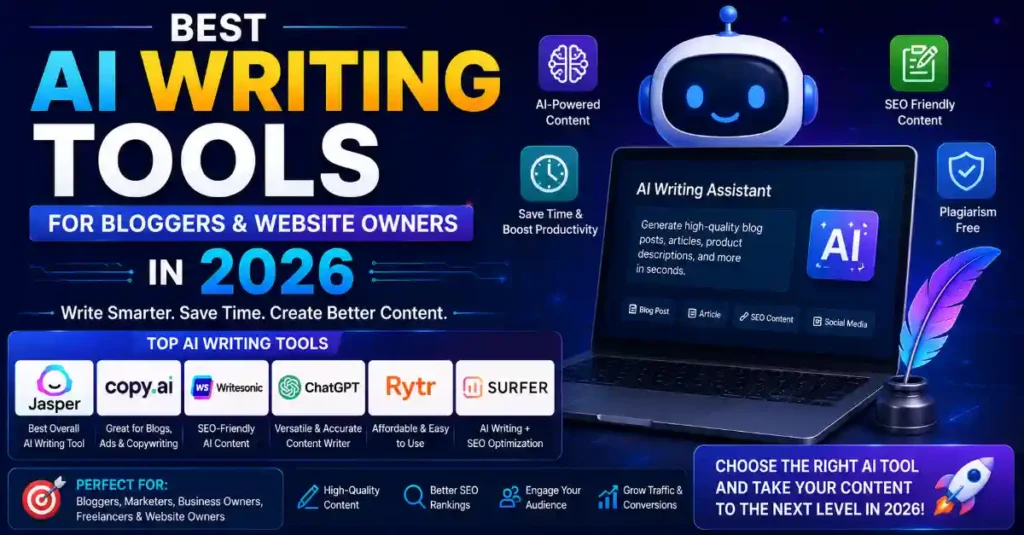
In this comprehensive guide, we’ll explore the top AI writing tools available in 2026, their key features, pricing structures, and how to select the perfect tool for your specific needs.
What Are AI Writing Tools?
AI writing tools are software applications powered by machine learning and natural language processing that help you create, edit, and optimize written content. These tools fall into two main categories according to their functionality.
AI text generators create original content from scratch based on your prompts and instructions. You provide a topic, keywords, and guidelines, and the tool produces complete articles, blog posts, or marketing copy.
AI writing assistants function more like sophisticated editors that refine existing text. They help improve grammar, suggest better word choices, optimize tone, and enhance overall readability.
Modern AI writing tools in 2026 go beyond simple text generation by incorporating SEO analysis, real-time search data, and content optimization features.
Top AI Writing Tools for Bloggers in 2026
ChatGPT (GPT-5)
ChatGPT remains one of the most versatile AI writing tools available in 2026. The latest GPT-5 model helps transform rough ideas into compelling writing with improved literary depth and rhythm.
Key strengths: ChatGPT excels at brainstorming, generating blog post drafts, expanding ideas, and providing editing suggestions. It handles everything from quick social media posts to long-form articles with ease.
Pricing: ChatGPT offers a free version with GPT-3.5, while the paid ChatGPT Plus subscription provides access to GPT-4 and GPT-5 models.
Jasper AI
Jasper AI has established itself as a leading choice for marketing teams and professional bloggers. The platform offers exceptional personalization and control over content output.
Key strengths: Jasper provides excellent templates for various content types while allowing freeform writing flexibility. This balance makes it ideal for bloggers who want guidance without feeling restricted.
Best for: Marketing content, brand-specific writing, and teams needing consistent voice across multiple pieces.
Grammarly
Grammarly functions primarily as an AI writing assistant that refines and polishes your existing content. It offers real-time grammar, spelling, and tone suggestions across multiple applications.
Key strengths: Grammarly excels at editing, improving clarity, and ensuring grammatical accuracy. The tool integrates seamlessly with browsers, email clients, and writing platforms.
Pricing: Grammarly offers a robust free version, with premium plans providing advanced suggestions and tone detection.
Surfer AI
Surfer AI stands out as arguably the best AI writer for SEO-focused content in 2026. Originally a content optimization platform, it now combines AI generation with powerful SEO features.
Key strengths: Surfer AI analyzes top-ranking content and provides real-time SEO scoring, keyword suggestions, and content structure recommendations. This makes it perfect for bloggers focused on search engine rankings.
Best for: SEO-optimized blog posts, articles targeting specific keywords, and content designed to rank highly in search results.
Writesonic
Writesonic is a popular choice for both long-form and short-form content creation. The platform includes built-in SEO features and automated text generation capabilities.
Key strengths: Writesonic offers robust grammar checking, content ideas generation, and natural language processing. It provides excellent guidance for moving from ideation to finished content quickly.
Pricing: Free plan includes 10,000 words per month, with paid versions starting at $13 monthly.
Copy.ai
Copy.ai serves content teams with over 90 tools and templates for various writing needs. The platform requires minimal human input to generate copy, outlines, and creative ideas.
Key strengths: Copy.ai includes an SEO-Optimized Blog workflow that scrapes search results to generate outlines and talking points for each heading. This streamlines the entire content creation process.
Pricing: Free version provides 2,000 words monthly, while the paid plan offers unlimited words at $49 per month.
Rytr
Rytr is widely used for both short-form and long-form content creation. The platform offers customizable tone settings and creativity levels to match your brand voice.
Key strengths: Rytr excels at social media posts, product descriptions, emails, and blog articles. It’s particularly beginner-friendly with straightforward templates.
Pricing: Free version includes 10,000 words monthly, with paid plans starting at $9 per month.
AIOSEO AI Assistant
AIOSEO offers a complete blog post generator integrated directly into WordPress. The tool helps brainstorm titles, generate outlines, and write full paragraphs for each section.
Key strengths: Seamless WordPress integration makes AIOSEO ideal for WordPress bloggers who want AI assistance without leaving their editor.
Best for: WordPress website owners, bloggers using WordPress platform, and those seeking native editor integration.
Benefits of Using AI Writing Tools
Increased Productivity
AI writing tools help you create content significantly faster than traditional writing methods. What once took hours can now be completed in minutes, allowing you to produce more content consistently.
Improved Content Quality
These tools assist in refining ideas, improving consistency, and enhancing overall writing quality. They catch grammar errors, suggest better phrasing, and help maintain a professional tone throughout your content.
SEO Optimization
Modern AI writing tools integrate SEO features that help your content rank higher in search results. They analyze keywords, suggest content structure, and optimize for search engine visibility.
Cost Efficiency
Using AI writing tools reduces the need for extensive editing services or multiple content writers. Many platforms offer free or affordable plans suitable for individual bloggers and small businesses.
Overcoming Writer’s Block
AI tools excel at generating topic ideas, creating outlines, and providing starting points when you’re stuck. This helps maintain consistent content output even during creative slumps.
Key Features to Look For
Content Generation Capabilities
Look for tools that can handle your specific content types, whether blog posts, landing pages, product descriptions, or social media content. Different tools excel at different formats.
SEO Integration
Choose platforms that offer built-in SEO analysis, keyword suggestions, and content optimization features. This ensures your content is both well-written and search-engine friendly.
Customization Options
The best AI writing tools allow you to customize tone, style, and creativity levels to match your brand voice. This personalization ensures content consistency across all your publications.
Multi-Language Support
If you create content in multiple languages, verify that your chosen tool supports all necessary languages. Many platforms now offer 24+ language options.
Integration Capabilities
Consider how the tool integrates with your existing workflow, whether that’s WordPress, Google Docs, or other content management systems.
How to Choose the Right AI Writing Tool
Define Your Content Needs
Start by identifying what type of content you create most frequently. Long-form blog posts require different features than short social media updates or product descriptions.
Consider Your Budget
AI writing tools range from completely free options to premium subscriptions costing $49-$99 monthly. Evaluate which features justify the cost based on your content volume and quality requirements.
Evaluate SEO Requirements
If search engine rankings are crucial for your blog or website, prioritize tools with robust SEO features like Surfer AI or specialized SEO writing assistants.
Test Multiple Platforms
Many AI writing tools offer free trials or free versions. Test several options to find which interface, output quality, and features best match your workflow.
Assess Learning Curve
Some platforms are more beginner-friendly while others offer advanced features requiring more training. Choose a tool that matches your technical comfort level and available learning time.
Best Practices for Using AI Writing Tools
Provide Detailed Prompts
The quality of AI-generated content directly depends on the clarity and detail of your input. Include target keywords, desired word count, target audience, tone preferences, and specific points you want covered.
Always Edit and Humanize Output
AI-generated content often sounds robotic or generic without human refinement. Add personality, storytelling elements, and natural flow that resonates with your specific audience.
Fact-Check Everything
AI tools can generate incorrect or misleading information through “hallucinations”. Always verify statistics, industry trends, and factual claims before publishing.
Maintain Your Unique Voice
Use AI as a writing partner, not a replacement for your creativity. Edit AI drafts to match your distinctive style and ensure consistency with your brand identity.
Optimize for User Experience First
While SEO is important, prioritize user experience above keyword optimization. Use clear headings, relevant images, compelling introductions, and proper formatting for readability.
Monitor Performance and Iterate
Track your content’s performance in Google Search Console and analyze engagement metrics. Use this data to refine your AI writing approach and build on what works.
Common Mistakes to Avoid
Over-Reliance on AI
AI should support your work, not completely replace human creativity. The most effective content combines AI efficiency with human insight and expertise.
Skipping the Editing Process
Publishing AI-generated content without thorough editing leads to generic, impersonal material that fails to engage readers. Always review and refine AI outputs multiple times.
Ignoring SEO Balance
AI can help with keyword integration, but overusing terms creates unnatural content. Place keywords strategically while prioritizing readability and genuine value for readers.
Using Vague Prompts
Generic or unclear prompts produce generic content. Be specific about your goals, audience, key points, tone, and desired outcomes to get better results.
Neglecting Brand Consistency
AI doesn’t automatically understand your brand’s unique tone and voice. Guide it with detailed instructions and adjust outputs to maintain consistency across all content.
Comparison Table: Top AI Writing Tools 2026
Frequently Asked Questions
1. Are AI writing tools worth it for small bloggers?
Yes, AI writing tools are extremely valuable for small bloggers. They help overcome writer’s block, increase content output, and improve quality without requiring expensive editing services. Many platforms offer free or affordable plans perfect for individual bloggers just starting out.
2. Can AI-generated content rank well in search engines?
Yes, when used correctly, AI-generated content can rank well in search engines. Modern AI tools are specifically designed for SEO and can help create well-optimized content. However, you must review, fact-check, and enhance AI outputs with human expertise to ensure quality and accuracy.
3. How do I prevent AI-generated content from sounding robotic?
To prevent robotic-sounding content, always edit and humanize AI outputs. Add personality, vary sentence structures, use synonyms and alternative phrasing, incorporate storytelling elements, and ensure natural flow. Think of AI as creating first drafts that you refine with your unique voice and style.
4. Which AI writing tool is best for SEO optimization?
Surfer AI is widely considered the best AI writing tool for SEO optimization in 2026. It combines AI content generation with comprehensive SEO analysis, real-time scoring, keyword suggestions, and content structure recommendations based on top-ranking pages.
5. Can I use multiple AI writing tools together?
Absolutely, many successful bloggers use multiple AI writing tools together. For example, you might use ChatGPT for initial drafts, Grammarly for editing and refinement, and Surfer AI for SEO optimization. Different tools excel at different tasks, so combining them creates a powerful content creation workflow.
6. Do AI writing tools work for languages other than English?
Yes, most modern AI writing tools support multiple languages. Platforms like Writesonic offer 24+ language options, making them suitable for multilingual content creation. However, always have native speakers review AI-translated content to ensure cultural accuracy and proper nuances.
7. How much does AI writing software typically cost?
AI writing tool pricing varies significantly. Many platforms offer free versions with limited word counts (typically 2,000-10,000 words monthly). Paid plans range from $9-$13 for basic subscriptions to $49-$99 for professional plans with unlimited content generation. Premium enterprise solutions can cost more depending on team size and features.
Conclusion
AI writing tools have become essential assets for bloggers and website owners in 2026, offering unprecedented capabilities for content creation, optimization, and refinement. From versatile platforms like ChatGPT to SEO-focused tools like Surfer AI, there’s an AI writing assistant suited for every content creator’s needs and budget.
The key to success lies in choosing the right tool for your specific requirements, providing detailed prompts, and always adding human expertise to AI-generated content. Remember that AI should enhance your creativity and productivity, not replace your unique voice and insights.
Start by testing free versions of several platforms to find which workflow feels most natural for your content creation process. As you gain experience, you’ll discover how to combine different tools and techniques to create high-quality, engaging content that resonates with your audience and performs well in search results.
The future of content creation is a collaboration between human creativity and AI efficiency—embrace these tools to take your blogging and website content to new heights in 2026.