
AI website builders have moved from “cool experiment” to “serious business tool” in 2026.
Now, you can launch a polished site or landing page in minutes using plain‑English prompts instead of wrestling with code or complex templates.
This guide compares the top AI website builder tools in 2026, highlights who they’re best for, and breaks down real pros, cons, and costs.
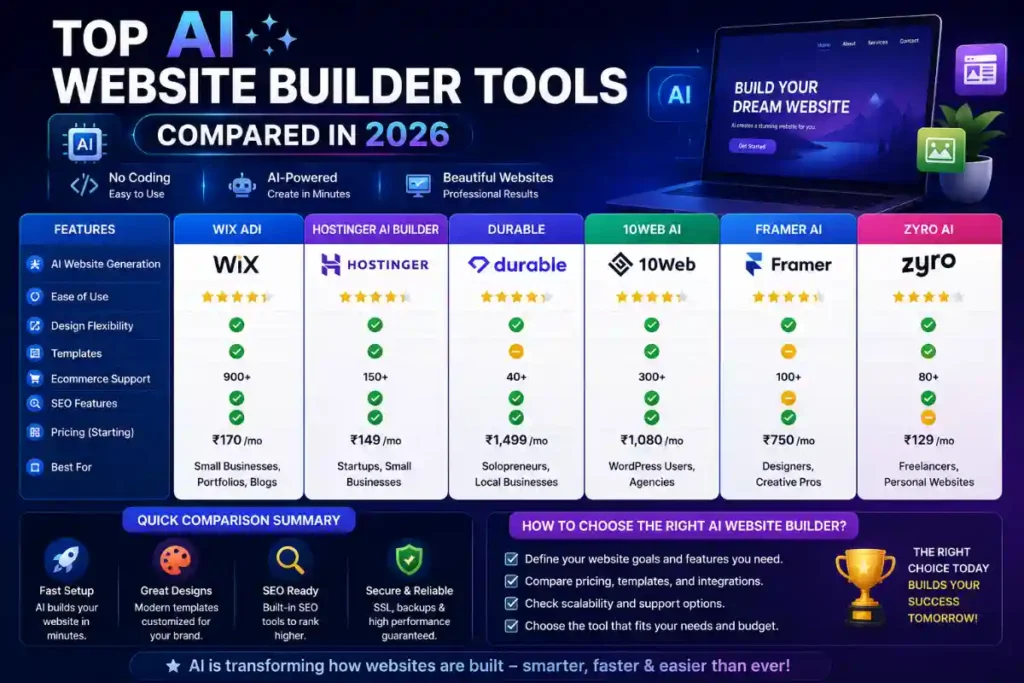
Whether you’re a solopreneur, freelancer, agency, or small business, you’ll walk away knowing exactly which AI website builder fits your use case and budget.
What Is an AI Website Builder in 2026?
An AI website builder uses artificial intelligence to generate page layouts, copy, images, and even site structure based on a short description of your business or idea.
Instead of manually choosing templates and dragging elements, you answer a few questions, describe your brand, and the tool builds a working site automatically.
Most modern builders combine:
- Text‑to‑site or prompt‑based generation
- Editable blocks and sections
- AI copywriting and image suggestions
- Hosting, domains, analytics, and forms
In 2026, the best AI website builders go beyond “pretty templates” and aim to generate conversion‑ready, SEO‑friendly sites straight out of the box.
Who Is Searching for AI Website Builders in 2026?
User intent around “AI website builder 2026” typically falls into three buckets:
- Launch quickly: Entrepreneurs and small businesses who want a live site this week, not after a month-long dev cycle.
- Improve design quality: Creators, designers, and agencies who want better layouts and faster iterations.
- Cut costs and complexity: Non‑technical founders who can’t justify custom development but still want a professional web presence.
So the primary search intent is commercial investigation: people want to compare AI website builders, understand trade‑offs, and then sign up for a free trial or affordable plan.
Top AI Website Builder Tools in 2026 (At a Glance)
Here are some of the most talked‑about AI website builders in 2026:
- ChilledSites – Fast, high‑quality, all‑inclusive AI website builder.
- Wix ADI / Wix AI – Popular all‑in‑one builder with AI assistance.
- Squarespace AI – Design‑driven builder with AI‑powered setup.
- Framer AI – Visual, animation‑heavy sites for designers and startups.
- Webflow + AI – Advanced design control plus AI layout/content assistance.
- Durable – Ultra‑fast generation focused on small business sites.
- Hostinger AI Website Builder – Affordable hosting + AI site builder bundle.
- LandingHero.ai – AI landing page builder for marketers.
- Lovable – AI app/site builder focused on speed and simple workflows.
Below, we’ll compare the leading options based on speed, design, ease of use, and pricing.
Side‑by‑Side: Best AI Website Builder Tools in 2026
Quick comparison table
(Prices are indicative ranges from 2025–2026 reviews and may vary by region and promo.)
ChilledSites: Fast, All‑Inclusive AI Website Builder
ChilledSites is frequently rated as one of the best AI website builders of 2026 for its balance of speed, quality, and value.
In hands‑on tests where reviewers built 24 real websites across multiple tools, it consistently produced the most polished outcome in about 60 seconds.
You type a plain‑English description of your business, tone, and goals, and the platform generates a complete, professional site—design, copy, forms, and all.
Hosting, custom domain support, analytics, and forms are bundled into a simple all‑inclusive price, starting from around £9–£29 per year depending on the plan.
Best for:
- Non‑technical founders who want “describe it and it’s live” simplicity
- Agencies who need to spin up many client sites quickly
- Freelancers who value speed without sacrificing design quality
Pros:
- Very fast generation (around 60 seconds per site)
- Output feels genuinely custom vs generic template
- Hosting, forms, and analytics included
- Less granular design control than Webflow or Framer
- Newer brand compared to Wix/Squarespace, so smaller ecosystem
Wix AI / ADI: Mainstream AI Website Builder
Wix has been a big name in site builders for years, and in 2026 its AI tools (like Wix ADI and newer AI features) help users generate a site much faster than starting from a blank template.
You answer a few questions about your business, and Wix ADI creates a site with relevant sections, images, and layout.
Because Wix is an all‑in‑one platform, you also get access to an app marketplace, e‑commerce features, SEO tools, and marketing add‑ons.
It’s not the most advanced AI on this list, but the total ecosystem makes it a safe choice for small businesses that expect to grow.
Best for:
- Users who want a familiar website builder plus AI help
- Small businesses needing bookings, e‑commerce, or appointments
- Bloggers and creators who want plenty of templates
Squarespace AI: Design‑First AI Builder
Squarespace has layered AI features on top of its already design‑driven platform, helping you set up pages, copy, and layouts faster.
Creative professionals like photographers, designers, and studios still love Squarespace for its typography, visual polish, and built‑in portfolio features.
AI comes into play during onboarding, layout recommendations, and content suggestions.
You don’t get fully “text‑to‑site in 60 seconds” output, but you do get a guided flow that leads to an aesthetically pleasing site in 5–15 minutes.
Best for:
- Visual portfolios and personal brands
- Creatives who care deeply about aesthetics
- Users who prefer opinionated, “hard to make ugly” templates
Framer AI: Modern, Animated Sites in Minutes
Framer AI targets startups and designers who want sleek, interactive marketing sites without writing code.
Reviews note that it creates some of the most visually impressive AI‑generated designs, with smooth animations and strong typography.
You describe your project, and Framer generates a full landing page you can tweak visually.
It’s especially popular for SaaS startups, launch pages, and product marketing experiments.
Best for:
- Startups needing modern landing pages fast
- Designers who want to fine‑tune visuals after AI generation
- Product teams running many A/B tests
Webflow + AI: Maximum Control With Smart Assistance
Webflow is long‑known for giving designers almost pixel‑perfect layout control in a no‑code environment.
With AI assistants, it now helps generate page structures, sections, and content, speeding up an otherwise complex build process.
It’s not the quickest “type one prompt, get site” option, but it’s ideal if you want a custom design that still benefits from AI scaffolding and copy suggestions.
Many agencies and advanced freelancers use it to deliver bespoke sites without touching raw code.
Best for:
- Designers and agencies requiring custom layouts
- Complex marketing sites and web experiences
- Users comfortable with a learning curve in exchange for control
Durable: AI Website Builder for Small Businesses
Durable is an AI website builder that focuses on speed for local and small business sites like barbers, coaches, or local services.
In many tests, it generated usable sites extremely quickly, though often with less design finesse than top design‑centric tools.
It’s great if you just need something live to capture leads, display services, and show contact details.
If you’re picky about visual details, you might outgrow it faster than Framer or Webflow.
Hostinger AI Website Builder: Hosting + AI in One
Hostinger bundles a lightweight AI website builder into its hosting plans, making it one of the easiest ways for beginners to get online.
You pick a plan, answer some questions, and the AI generates a functional site that you can tweak.
Many 2026 creators and YouTubers highlight Hostinger as a cost‑effective way to get both hosting and an AI website builder without juggling multiple providers.
It’s particularly attractive when discounted promos bring the effective monthly price down significantly.
Best for:
- Beginners starting their first site
- Budget‑conscious users who still want a custom domain and email
- Anyone who prefers a simple, bundled solution
LandingHero.ai: AI Landing Page Specialist
LandingHero.ai focuses on quickly generating high‑converting landing pages, portfolios, and business sites.
It combines AI page generation with instant publishing and even code export, which is useful if you want to host elsewhere or integrate with a custom stack.
This makes it a strong pick for marketers who run campaigns and need pages launched in hours, not weeks.
You can generate multiple variations, test different angles, and iterate based on performance.
Lovable and “Developer‑Friendly” AI Builders
Tools like Lovable and Replit‑style builders target users who want AI to handle a lot of the scaffolding while still allowing code‑level access.
Lovable, in particular, is often praised in 2026 roundups as fast and “vibes‑driven,” meaning it focuses on quickly giving you something that feels on‑brand.
These tools are great if you’re building not just a marketing site but simple apps or more interactive experiences.
They blur the line between AI website builder and AI app builder.
Key Benefits of AI Website Builders in 2026
Using an AI website builder in 2026 brings several concrete advantages over traditional approaches:
- Speed to market: Generate a functional site in minutes instead of weeks.
- Lower cost: Avoid large upfront developer fees; most tools are subscription‑based and affordable.
- Less technical friction: No need to manage hosting, security, or complex CMS setup.
- Consistent design: AI systems apply modern design patterns, spacing, and typography by default.
- Built‑in SEO helpers: Many tools suggest headings, meta tags, and content structure aligned with search intent.
For non‑technical business owners, this means you can move from idea to live website in a single afternoon.
How to Choose the Best AI Website Builder for You
Step‑by‑step selection process
- Clarify your primary goal
Decide if you need a general business site, portfolio, blog, or performance‑driven landing pages. - Set your customization level
- Check integrations and ecosystem
Think about email marketing, booking systems, and analytics. Wix and Squarespace have mature app ecosystems, while others integrate via code or third‑party tools. - Compare pricing vs. features
Don’t just look at monthly fees; factor in hosting, domain, forms, and analytics. ChilledSites stands out for its all‑inclusive pricing, whereas some platforms charge extra for add‑ons. - Test output quality
Use free trials to generate a site with the same prompt across 2–3 platforms.
Compare design, copy quality, mobile responsiveness, and ease of editing. - Think about long‑term scalability
If you expect to add complex features later, start on a platform that can grow with you, like Webflow, Wix, or Framer.
Common Mistakes When Using AI Website Builders
Many users make similar errors when they first switch to AI website builders. Here are pitfalls to avoid:
- One‑shot prompts only: Relying on a single, vague prompt like “make a website for my business” often leads to generic results.
- No brand input: Skipping details about tone, audience, and brand personality makes your site feel bland.
- Ignoring SEO basics: Assuming AI will handle everything and never adjusting headings, meta descriptions, or internal links.
- Not editing AI copy: Publishing the first AI‑generated text without tailoring it to your offer and market.
- Choosing only on price: Picking the cheapest tool without considering design quality, support, and scaling needs.
Treat AI as a strong starting point, not a full replacement for thoughtful editing and brand strategy.
Tips to Get Better Results from an AI Website Builder
Use these practical tips to make your AI‑generated site look and perform like it was handcrafted:
- Write detailed prompts: Include your industry, target audience, core offer, tone (e.g., “friendly but expert”), and desired actions (e.g., “book a call”).
- Build section by section: For landing pages, many experts recommend generating or refining hero, features, testimonials, and FAQ separately for better quality.
- Customize visuals: Swap generic stock images for real product photos, team shots, and brand‑consistent graphics.
- Refine SEO elements: Manually review and improve page titles, meta descriptions, and H1–H3 headings to match real search intent.
- Test and iterate: Use built‑in analytics or external tools to see what’s working and continue tweaking content and layout.
Important Highlights: 2026 AI Website Builder Trends
- AI website builders now generate complete, hosted sites in under a minute in some cases.
- Tools are shifting from “template pickers” to true text‑to‑site experiences using detailed natural language prompts.
- SEO has adapted: you now optimize not just for Google, but also for AI search engines and LLM‑driven discovery, which affects how you structure content.
- Design‑centric tools like Framer and Webflow use AI to speed up structure and copy while retaining human‑level visual control.
- All‑in‑one platforms (Wix, Squarespace, Hostinger) compete by bundling AI with domains, hosting, and marketing features.
FAQs About AI Website Builders in 2026
1. Are AI website builders good for SEO?
Yes—most leading AI website builders in 2026 produce clean, mobile‑friendly layouts and reasonable heading structures, which are good foundations for SEO.
However, you still need to refine keywords, meta tags, and internal linking based on real search intent, instead of relying 100% on AI defaults.
2. Can AI website builders replace web developers?
For simple business sites and landing pages, AI website builders can often replace a traditional developer for the first version of your site.
For complex, custom web apps or highly tailored experiences, developers and designers are still essential, even if they use AI tools to accelerate the process.
3. Which AI website builder is best for beginners?
If you’re completely new, Hostinger’s AI builder and Wix ADI are beginner‑friendly because they combine guidance, hosting, and domain setup in one place.
ChilledSites is also attractive for beginners who want ultra‑fast generation and all‑inclusive pricing without juggling multiple services.
4. How much do AI website builders cost in 2026?
Pricing varies, but many good AI website builders fall between roughly £9/year (for some all‑inclusive deals) and £15/month for more advanced platforms.
Costs can increase if you add e‑commerce, premium integrations, or multiple sites, so always check what’s included in each tier.
5. Can I move my AI‑generated site to another platform later?
Some tools, like LandingHero.ai, allow code export so you can host or customize your site elsewhere.
Others are more closed ecosystems, meaning you’d need to rebuild the site manually if you switch platforms, so it’s worth checking portability before committing.
6. Are AI‑generated designs unique or template‑based?
The best AI website builders combine templates with generative design logic, so your site won’t look exactly like anyone else’s, especially when you provide detailed prompts.
That said, layouts still follow modern web conventions, which is a good thing for usability and conversions.
Conclusion
In 2026, the question isn’t “Should I use an AI website builder?” but “Which AI website builder matches my goals, skills, and budget?”
From ultra‑fast, all‑inclusive tools like ChilledSites to design‑centric platforms like Framer and Webflow, there is now an option for almost every type of creator and business.
If you want speed and simplicity, start with ChilledSites, Durable, or Hostinger AI.
If you need deep design control, explore Webflow or Framer; and if you prefer a mature ecosystem with apps and marketing features, Wix or Squarespace remain strong choices.
Use AI for what it does best—fast generation, structure, and suggestions—then layer your own brand voice, strategy, and edits on top.
That combination is what turns an AI‑generated website into a long‑term digital asset that actually wins customers in 2026 and beyond.